Many thanks to those who attended the rally, from the club members who helped set up and manned the doors and Bring & Buy, traders who came and offered something for everyone to see and buy, and the visitors who made it another great rally.
Again members of the club will be going up the hill to operate a portable station for the Practical Wireless 144MHz QRP contest on Sunday 9th June 2024. We will be using the callsign GM4YEQ/P.
The contest runs between 0900-1500 UTC (1000-1600 Local/BST). We’ll likely be on-site by 0915 (local) if not earlier for setting up.
We’ll be at the usual “Middle Swire” location between the Yarrow and Ettrick valleys 6 miles west of Selkirk.
All club members are welcome to come and visit and catch up for a few hours, assist with setting up or operating, or operate your own sets on HF away from urban QRM.
Or if not able to come to the site, please give us a shout on 2m simplex FM or SSB if you hear us (144.150-144.397MHz is the SSB range). Someone will likely be scanning simplex channels 145.200-575MHz through the day. The more contacts we get (even local ones) the more points we get multiplied by the number of locator squares. Calling CQ on 145.500 isn’t allowed so don’t just listen for us there (nor on the repeaters)! Individual members may be monitoring repeaters and calling channels though if you want to make contact with someone in the group.
Exchange will be signal report, serial number (if you’re not participating then give 001 for your first contact) and your Maidenhead grid reference (or approximate location if you don’t know it as it still counts as a contact just not a new grid square).
Visitors should bring their own food and drink if they’re staying all day. Bring suitable clothing in case it’s windy or wet and footwear suitable for a grass field (with sheep droppings!). Dogs under strict control.
OK, I’d been bouncing signals off the Moon ever since I put up the antenna system a fortnight before. Just that I didn’t know there was anyone on the other end to decode my 13-character message. Until, that is, on the 12th Mr Potts, callsign NC1I, replied from Massachusetts, USA.
Successful QSO between GM8JBJ and NC1I shown on WSJT-X screen.
Moonbounce (or Earth-Moon-Earth, EME) communication is a very cool thing to do. Just imagine the cred you’d get when next in a bar and you throw that out there when things go quiet.
And importantly, anyone can do it.
Background
The Moon is about 400,000km away (less at perigee, more at apogee). Hence, the flight time for a signal from Earth to Moon and back is about 2.7 seconds. The corresponding round-trip free-space path loss for a signal is a huge 400dBi – no way anyone can bridge that gap. But whilst the Moon is a poor point reflector with a reflection coefficient of 6.5%, it’s also a 3,500km diameter billboard that reflects from all points across its area. The result is a real total path loss of around 250dBi and that’s (just) low enough for radio amateurs to exploit our natural satellite to communicate almost globally.
Basic Kit
Today, almost everyone uses Joe Taylor (K1JT)’s ultra-narrow-band algorithms to code and send a very short message. The message is pared to the bone – it’s even skinnier than FT8. And using his software, WSJT-X, this is sent repeatedly. So, you need a computer, a sound card, and the application. The setup is the same as for FT8, but you’ll configure to use Q65B with a 60-second period.
The transmission modulates the audio of a rig and uses upper sideband (USB). The simplest bands for moonbounce are 144MHz and 432MHz. 1296MHz is another option, but above 432MHz you’ll need a high stability reference to hold the frequency steady and 23cm kit gets expensive. Of course, you could do it at any GHz frequency amateur band, but I’m assuming no-one starts at 10GHz or the like. So, you need a VHF/UHF SSB rig.
And then there’s the antenna.
Antenna
There are three options when it comes to antennas: huge, big, and modest. Huge VHF/UHF antennas are for Americans and others with acres of land. They are typically 48 or more stacked and bayed Yagis. Since you must point at the Moon, you can imagine the mechanics and electronics to automatically rotate and elevate 48 Yagis. Radio amateurs with huge antennas are the heavy lifters of the moonbounce world. Without them, novices wouldn’t get off the ground.
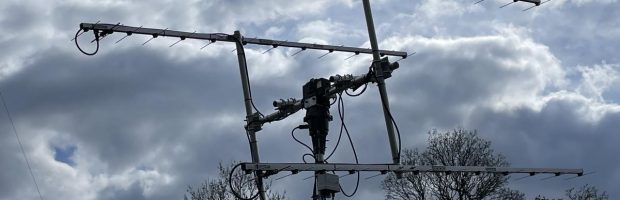
Then there’s big. ‘Big’ describes folk like me who put up four or more Yagis. That’s easily done. It’s all standard kit. My antennas are on a five-metre scaffold pole. Yaesu and others make az/el rotators, and at VHF/UHF the feeder doesn’t cost a mortgage. Automatic Moon tracking can be done on an Arduino or the like. And many folk in this bracket run 500W.
Finally, there’s modest. There’s a whole movement of folk who use single Yagis and a barefoot rig. And many of those use a lightweight long Yagi mounted on a homebrew tripod. The advantage of this is that you can also avoid spending on a rotator, or on a low noise pre-amp (since you’ll be close to the Yagi feed point). These simple systems are often used /P from some piece of open high ground.
There are two. Belief (that you can do it). And patience.
It also helps if you do a lot of research to optimise your kit.
Results
The software does everything for you. But you must do the research to know when is best to try.
Conclusion
The truth is that Moonbounce is not that easy. There are several propagation mechanisms that will thwart your attempts.
First, there’s Faraday rotation. The polarisation of the transmitted wave is sometimes distorted along the path. And there’s nothing you can do about it – save use rotatable antennas, and that’s hugely complex.
Then there’s libration fading. The Moon wobbles. And sometimes the reflected waves received back on Earth create an interference pattern in time with deep fades. There’s nothing you can do but wait till the effect stops.
And of course, it’s stupid to try when the Moon and Sun are both within your antenna’s beam. The Sun adds noise to a sensitive system. But you can just wait till the Moon is on its own.
And then there’s the little issue of few folk listening at any point in time. But you can always arrange a sked on a chat room.
None of these issues diminish its street cred. They even enhance it because they make it complicated.
But here’s the secret. Given the simplicity of the kit, anyone can do it.
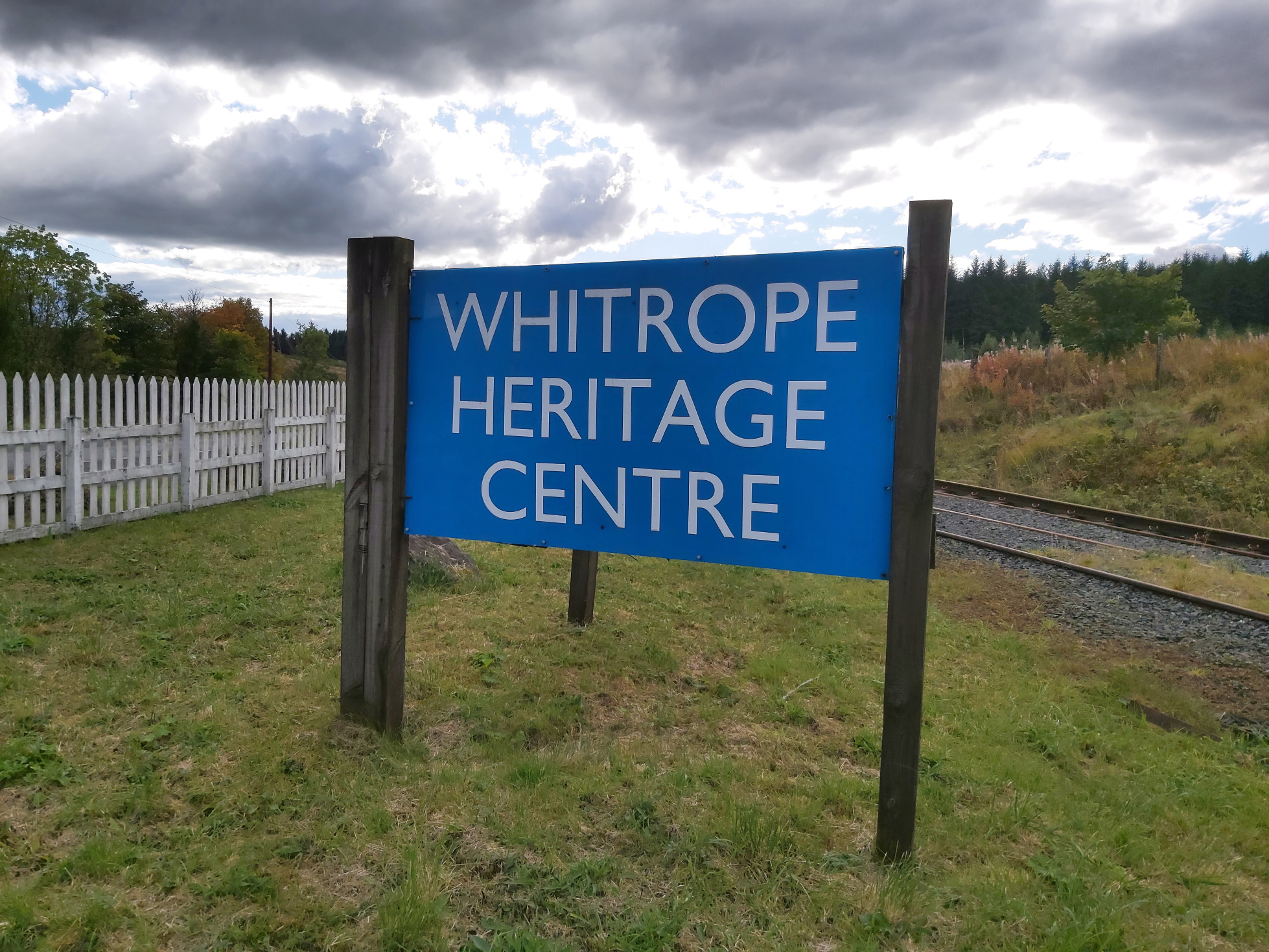
Club members will be taking part in this year’s Railways On The Air event, with a station being set up at the usual place of Whitrope Heritage Centre near Hawick on the weekend of 23/24 September.
The callsign used will be GB0WRH (Waverley Route Heritage) operating on HF bands. Dave MM0HTL will be arriving around 9am on Saturday and setting up, and then along with other members will be operating through the day and evenings until late Sunday afternoon.
All club members and visitors are welcome to come along and see the stations (radio and railway) and help with operating or just come along to chat with us.
The Whitrope Heritage Centre is run by the Waverley Route Heritage Association who have restored a length of track and sidings on the old Waverley line (1849-1969) between Hawick and Carlisle. Further details here: https://wrha.org.uk/about/
Location: Whitrope Heritage Centre, Whitrope, Hawick, Roxburghshire TD9 9TY Location: 11 miles south of Hawick on B6399 (Hawick to Newcastleton road).